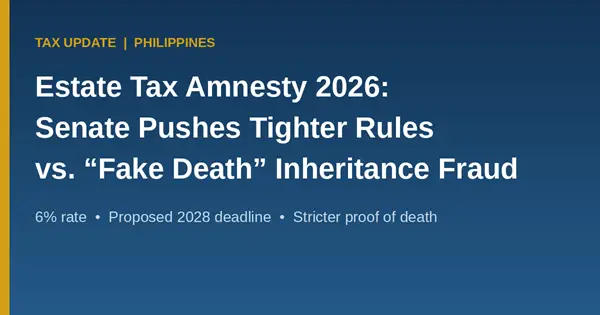
Senate Wants a Stricter Estate Tax Amnesty
The proposed fourth estate tax amnesty is facing tougher scrutiny in the Senate. During a hearing of the Senate committee on ways and means on Friday, October 23, 2026, lawmakers pushed to tighten the bill so it cannot be used for “fake death” inheritance fraud, and so taxpayers do not learn to wait for the next pardon before paying what they owe, according to The Philippine Star.
For heirs, accountants and property owners, the debate matters. It will decide how much time families have to settle old estates, what documents they must present, and how strict the Bureau of Internal Revenue (BIR) can be when processing applications.
What Happened at the Senate Hearing
Senate President Gatchalian warns about repeat amnesties
Senate President Sherwin Gatchalian cautioned that a fourth estate tax amnesty since 2019 may remove the urgency to pay. His concern is that taxpayers may start expecting another amnesty a few years later and skip paying altogether.
He also asked the Department of Finance (DOF) to study why many estates remain unsettled. In particular, he questioned whether the baseline 6% amnesty rate is still too costly for poor families who only need to transfer small rice fields or rural lands.
Lacson rejects barangay certification in place of death certificates
Committee chairman Panfilo Lacson cautioned against a proposal to accept barangay certifications instead of Philippine Statistics Authority (PSA) death certificates for heirs in remote areas. He described the certification process, which relies on the barangay chairman and two disinterested witnesses, as too subjective and open to abuse through fake deaths for inheritance.
A firmer cutoff for the availment period
Lacson also proposed a stricter cutoff mechanism so the government actually collects the revenue. The DOF proposed that the availment period end on June 30, 2028.
How We Got Here: Timeline of Estate Tax Amnesty Laws
Law | Availment period | Coverage |
RA 11213 (Tax Amnesty Act), implemented by BIR Revenue Regulations 6-2019 | Original period ended June 14, 2021 | Decedents who died on or before December 31, 2017 |
RA 11569 (signed June 30, 2021) | Extended to June 14, 2023 | Same coverage |
RA 11956 (lapsed into law August 5, 2023), implemented by RR 10-2023 | Extended to June 14, 2025 | Decedents who died on or before May 31, 2022 |
The BIR later advised that the final day to file, get approval and pay was Monday, June 16, 2025, because June 14 fell on a weekend. After that date, unsettled estates reverted to the regular estate tax regime, as PwC Philippines explained.
Participation has been uneven. Based on BIR data cited in a Senate explanatory note, only about P2.5 billion was collected from almost 43,700 filers as of May 2021. A later Senate note cited about P7.4 billion collected since 2019.
Where the Bill Stands Now
The extension has broad support, but its details are still moving.
- House of Representatives: The House ways and means committee approved a consolidated substitute bill extending the amnesty to December 31, 2028, according to BusinessWorld as republished online.
- Department of Finance: The DOF backed House Bill 6614 and said the extension would help families formalize inheritance and put idle assets to productive use. Its proposal includes documentary requirements, payment by the deadline and installment payments spread over one year from the issuance of the Acceptance Payment Form (APF), as stated in the DOF press release.
- Senate: Several bills have been filed, including measures from Senators Zubiri, Go and Estrada, with deadlines of either June 14, 2028 or December 31, 2028. Coverage dates also differ by bill. Bloomberg Tax reported that Senate Bill 1866 would cover decedents who died on or before December 31, 2024, while the DOF described House Bill 6614 as covering deaths on or before May 31, 2022.
Because the bills differ, the final law may change the deadline, coverage date, proof-of-death rules and payment terms. Watch for the version that is finally enacted.
How Estate Tax Amnesty Worked Under Previous Rules
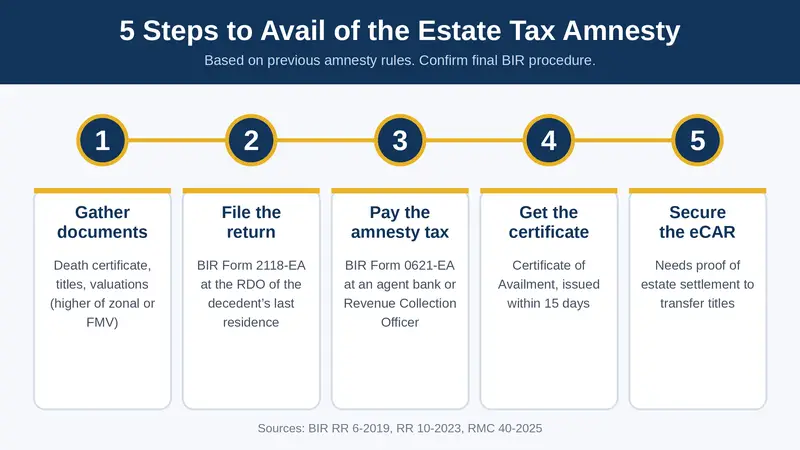
The steps below reflect earlier amnesty rules and are useful for planning. Confirm the final procedure once a new law and BIR regulations are issued.
- Gather documents. These typically include the death certificate, proof of ownership of properties, and valuations based on the higher of the zonal value or the assessor’s fair market value.
- File the Estate Tax Amnesty Return (BIR Form 2118-EA) with the proper RDO, or electronically or through an authorized agent bank where allowed.
- Pay the amnesty tax using the Acceptance Payment Form (BIR Form 0621-EA) through an authorized agent bank or Revenue Collection Officer.
- Receive the Certificate of Availment. Under earlier rules the RDO issued it within 15 calendar days after receiving the application with complete requirements, as noted by Grant Thornton Philippines.
- Secure the eCAR. The electronic Certificate Authorizing Registration was issued only after proof of estate settlement, such as an extrajudicial settlement or court order, under RR 10-2023. Properties omitted from the amnesty return were excluded from the eCAR unless additional amnesty payment was made within the period.
In April 2025, the BIR issued Revenue Memorandum Circular 40-2025 to clarify that missing proof of settlement by the deadline would not invalidate an amnesty application, according to Grant Thornton.
Why “Fake Death” Safeguards Matter
An amnesty reduces the tax burden, but it also allows the transfer of property titles. If proof of death is weak, a dishonest person could try to claim a living owner’s property. That is why senators are focused on the quality of documents. A PSA-issued death certificate is a government record that is hard to fabricate, while a barangay certification is easier to question.
The point is not to make life harder for rural families. It is to protect legitimate heirs and property owners, and to make sure the BIR and registries rely on verifiable records. A possible middle path is a stricter, well-documented process for remote areas, such as late registration of death with the local civil registrar and PSA.
What If You Miss the Amnesty?
After an amnesty ends, the regular rules in the National Internal Revenue Code apply. The base estate tax rate remains 6% under the TRAIN Law, but surcharges and interest can be added for late filing and payment, and the amnesty’s protection no longer applies. PwC noted that installment settlement may be possible in some cases, subject to BIR approval.
Practical Tips for Heirs, Families and Property Owners
- Do not wait for another amnesty. Lawmakers are questioning repeated extensions, so the next window may be shorter or stricter.
- Start collecting documents now. Secure PSA death certificates, tax declarations, titles and proof of heirship.
- Correct civil registry gaps early. If a death was never registered, begin late registration.
- List all properties. Omitted properties may not be covered by the eCAR.
- Ask about installment options. The DOF proposal includes a one-year installment period.
- Watch official issuances. Check the BIR website for revenue regulations and memorandum circulars once the bill becomes law.
Why Work With a Licensed CPA
Estate tax computation involves valuation, deductions, proof of ownership and compliance deadlines. A mistake can delay an eCAR or leave properties uncovered. Engage a CPA licensed by the Professional Regulation Commission (PRC) and verify the license on the PRC website. Professional bodies such as the Philippine Institute of Certified Public Accountants (PICPA) and the Association of Certified Public Accountants in Public Practice (ACPAPP) can help you find practitioners and updates. The accountancy profession is regulated by the Board of Accountancy under the PRC. For legal matters such as extrajudicial settlement, also consult a lawyer.
Frequently Asked Questions
Is the estate tax amnesty extension already a law?
No. As of October 26, 2026, the proposal is still being discussed in the Senate, based on the Philstar report. The final terms may change.
What is the estate tax amnesty rate?
The baseline rate under previous programs and the current proposal is 6% of the net estate, with a minimum amnesty tax of P5,000 under earlier laws. Senators have asked whether the rate is too high for poor families.
What is the proposed deadline?
The DOF proposed June 30, 2028. The House version points to December 31, 2028. The Senate may set a firm cutoff.
Can a barangay certificate replace a PSA death certificate?
That proposal was challenged at the hearing. The chairman of the ways and means committee said it could be too subjective and open to fake-death claims.
Where do I file?
Under earlier rules, heirs filed with the BIR Revenue District Office that covers the decedent’s last residence, or through authorized channels. Check BIR announcements for the new procedure.
Key Takeaways
- Senators want stricter safeguards in the fourth estate tax amnesty.
- The 6% rate, deadline and proof-of-death rules are the main points to watch.
- The DOF supports an extension to 2028 with a one-year installment option.
- Heirs should prepare documents now instead of waiting for another extension.
Disclaimer This article is for general information and is not legal, tax or accounting advice. The bill is still pending, so details may change. Confirm requirements with the BIR and a licensed professional. |
Sources and References
- The Philippine Star, “Tighter estate tax amnesty bill pushed in Senate,” October 24, 2026: https://www.philstar.com/headlines/2026/10/24/2565344/tighter-estate-tax-amnesty-bill-pushed-senate
- Department of Finance, “Sec. Go greenlights extension of Estate Tax Amnesty,” December 9, 2025: https://www.dof.gov.ph/go-greenlights-extension-of-estate-tax-amnesty-to-reducefinancial-burden-on-filipino-families-settling-obligations/
- Republic Act No. 11956 (Supreme Court E-Library): https://elibrary.judiciary.gov.ph/thebookshelf/showdocs/2/96664
- Senate of the Philippines, text of RA 11956: https://legacy.senate.gov.ph/republic_acts/ra%2011956.pdf
- Senate explanatory note on the 2023 extension: https://issuances-library.senate.gov.ph/sites/default/files/2023-06/4166937954%21.pdf
- Grant Thornton Philippines, RR 10-2023: https://www.grantthornton.com.ph/insights/articles-and-updates1/tax-notes/amendments-on-estate-tax-amnesty-deadline-extension/
- Grant Thornton Philippines, RMC 40-2025: https://www.grantthornton.com.ph/insights/articles-and-updates1/tax-notes/clarification-on-the-submission-of-proof-of-estate-settlement-for-availing-of-the-estate-tax-amnesty-extension/
- Grant Thornton Philippines, how to apply: https://www.grantthornton.com.ph/insights/articles-and-updates1/tax-notes/how-to-apply-for-estate-tax-amnesty/
- PwC Philippines, “Missed the estate tax amnesty? What now?”, June 19, 2025: https://www.pwc.com/ph/en/tax/tax-publications/taxwise-or-otherwise/2025/missed-the-estate-tax-amnesty-what-now.html
- SunStar, BIR advisory moving the deadline to June 16, 2025: https://www.sunstar.com.ph/cebu/estate-tax-amnesty-deadline-moved-to-june-16-says-bir
- Bloomberg Tax, Senate Bill 1866: https://news.bloombergtax.com/daily-tax-report-state/philippines-senate-considers-bill-to-further-extend-estate-tax-amnesty-program-2
- BIR Revenue Regulations 6-2019 and related issuances: https://www.bir.gov.ph
- Professional Regulation Commission: https://www.prc.gov.ph
- PICPA: https://www.picpa.com.ph
- ACPAPP: https://www.acpapp.org